
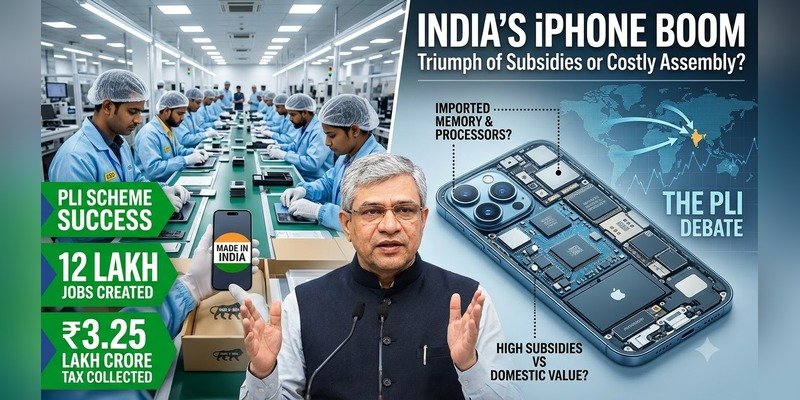
NEW DELHI: Union Minister Ashwini Vaishnaw has hit back at critics of India’s iPhone manufacturing push. He says the money spent on incentives has come back many times over through taxes and jobs. His reply, posted on X on Tuesday (October 27), followed a Bloomberg video report that asked whether India gets enough value from the public money it spends to attract phone makers.
The minister’s numbers
Under the mobile Production Linked Incentive (PLI) scheme, the government pays companies extra money for making more products in India. Vaishnaw, the Union Minister for Electronics and IT, said the government has paid Rs 19,000 crore in mobile manufacturing incentives. In return, it has collected Rs 25,000 crore in direct taxes and Rs 3 lakh crore in GST, about Rs 3.25 lakh crore in all.
He also said electronics manufacturing gives jobs to 25 lakh people, and 12 lakh of them work in making mobile phones. He ended his post with the internet slang “Cope harder!!”, a jab at people who doubt the scheme.
What Bloomberg asked
The report was made by Andy Mukherjee, a Bloomberg Opinion columnist. Filmed in Hong Kong’s Sham Shui Po area, the video shows him taking an iPhone apart to see what is inside. He asked whether India should even try to copy China’s success in high-tech manufacturing.
Mukherjee agreed that India has made real progress. Earlier, Indian factories imported ready-made mainboards, the main circuit board of a phone. Now they import bare circuit boards and fit the electronic parts here. He estimated that this has improved India’s mobile trade balance by $2.1 billion in a year. Roughly one in every four iPhones is now made in India.
But he also pointed to a big gap. India still imports memory chips, processors, displays, camera lenses and batteries. According to him, India spends more on bringing in these parts than it earns by exporting finished phones. If costs stay high, he warned, taxpayers could end up paying more in subsidies than factory workers earn in extra wages. Rising memory prices, partly because of demand from artificial intelligence, could make things even harder.
The bigger chip question
Mukherjee said India now wants to move into advanced semiconductors, which are much harder to make. Even with billions of dollars in support, he said, the country has only reached testing and packaging. A true high-end chip factory is still years away. In his view, India may do better by building on its strengths in engineering and design, and by backing industries like clothing and footwear that can employ tens of millions of people.
This echoes what former RBI governor Raghuram Rajan said in a Frontline magazine interview in September 2026. Rajan asked why India should spend so heavily on making chips when they can be bought from abroad. He argued that even with huge spending, India could not become fully self-reliant, because chip making needs machines and materials from other countries. He also said countries under export bans often get chips through middlemen, and that India should be choosier about which industries are truly vital. Fixing basics like education and the business environment, he said, matters too.
Zoho founder Sridhar Vembu disagreed. He said India must build its own abilities instead of assuming that other countries will always supply the technology it needs.
The government’s side
The Centre says its numbers prove that the plan is working. The PLI scheme links incentives to extra production. Figures given in Parliament in July 2025 showed that the large-scale electronics manufacturing scheme had drawn Rs 12,390 crore in investment and produced goods worth Rs 8.44 lakh crore by June 2025. Mobile phone exports under it reached Rs 4.65 lakh crore.
Apple and its partners are also making more in India as the company spreads its supply chain beyond China, a plan often called China-Plus-One. India is now the world’s second-largest mobile maker. Vaishnaw said in February that smartphones are India’s top export, worth $30 billion in 2025.