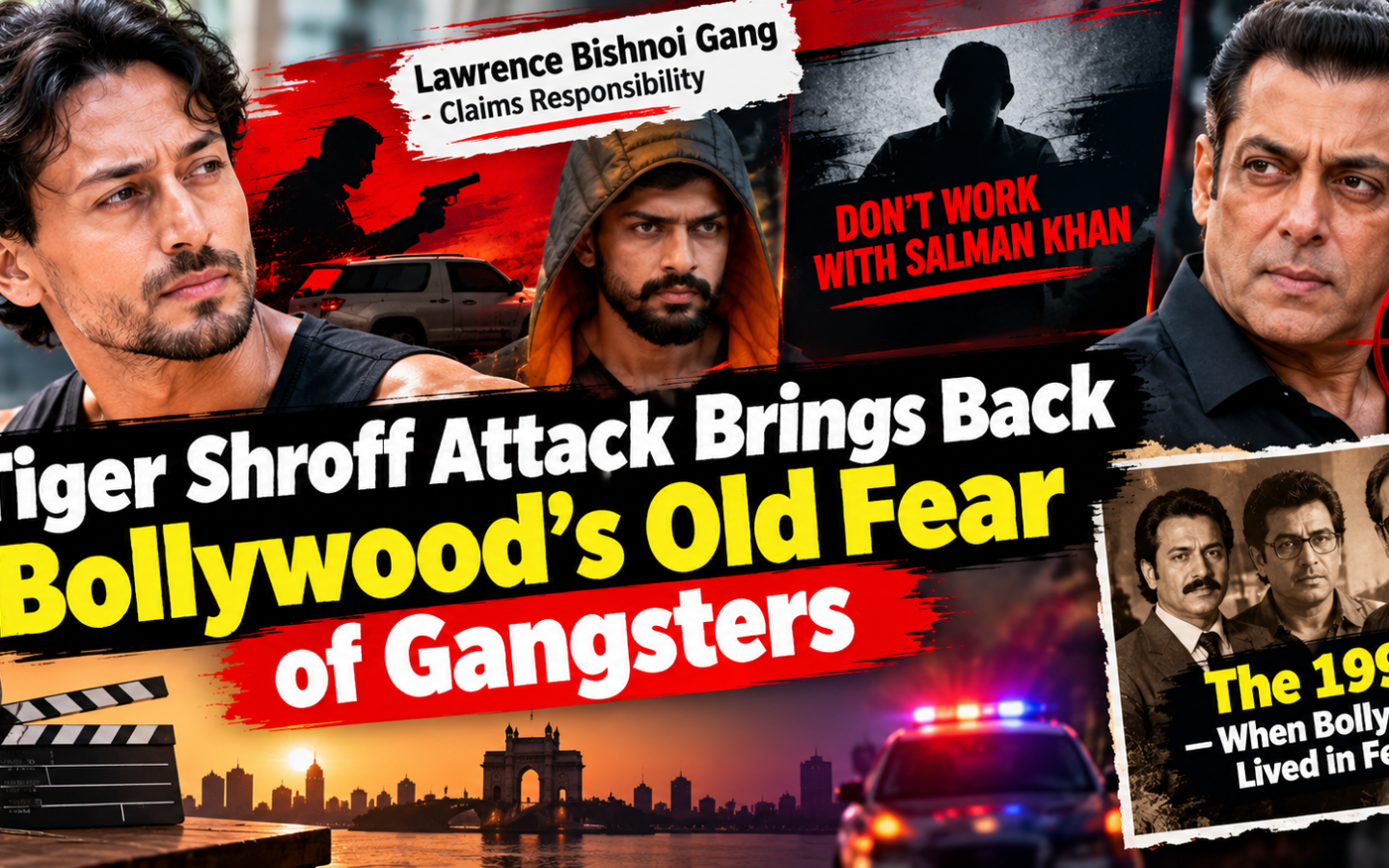
MUMBAI: The attack on actor Tiger Shroff last Sunday has scared the Hindi film industry. It has also brought back painful memories of the 1990s, when criminal gangs regularly targeted people in Bollywood.
Soon after the attack, the Lawrence Bishnoi gang claimed responsibility. It also warned Shroff not to work with superstar Salman Khan. Police questioning later revealed a worrying twist. Shroff was never the real target. The attackers had come to Mumbai to go after Salman Khan.
A gang that keeps targeting film stars
In recent years, the Bishnoi gang has gone after many people in the Hindi and Punjabi film industries, and Salman is one of its most prominent targets. He has received repeated threats linked to the 1998 blackbuck case, an old case about the hunting of a type of antelope.
The threats have turned into real attacks. In April 2024, shots were fired outside Salman’s home in Bandra. Gunmen linked to the gang also killed Baba Siddique, a former Maharashtra minister, in one of its most high-profile attacks.
Since then, the list has grown fast. Shootings have hit actor Gippy Grewal’s home in Canada, Kapil Sharma’s cafe, the family home of actor Disha Patani in Bareilly, and filmmaker Rohit Shetty’s house in Mumbai. Stars such as Ranveer Singh and Ayush Sharma have faced heavy demands for money. In May 2026, gunfire was reported outside the home of Diljit Dosanjh’s manager.
Almost every attack comes with an online message claiming responsibility, and it nearly always names Salman Khan as the reason.
Bollywood’s dark 1990s
This is not the first time the film world has lived in fear. In the 1990s, extortion, turf wars and money rivalries left a trail of violence. T-Series founder Gulshan Kumar, producer Mukesh Duggal, Javed Riyaz Siddique and Ajit Diwani were murdered. Filmmakers Rakesh Roshan, Rajiv Rai and Lawrence D’Souza survived targeted attacks.
The difference today is that the targets are not only producers and directors. They include some of Bollywood’s biggest stars.
The night a police officer got a warning
Senior police officer Rakesh Maria wrote about those years in his memoir, Let Me Say It Now. In the early hours of 22 April 1997, a trusted source called him with an urgent message. Gangster Abu Salem was planning to attack Gulshan Kumar near the Shiv temple the music boss visited regularly.
Maria called filmmaker Mahesh Bhatt, who was directing a film for Gulshan, and asked him to warn the producer. He also alerted the Crime Branch and arranged protection. Still, on 12 August 1997, Gulshan Kumar was shot dead outside the temple. The killing shocked the entire industry.
“They are going to kill Shah Rukh”
Around that time, Maria called Bhatt again with another warning. According to the book King of Bollywood Shahrukh Khan by Anupama Chopra, an informer had said Abu Salem wanted superstar Shah Rukh Khan killed. Bhatt was making two films with Shah Rukh and was asked to keep him indoors.
Shah Rukh reportedly laughed when he first heard it. He had received no direct threats and could not understand why anyone wanted him dead. He later met Maria, who told him to lie low. A police commando in plain clothes was assigned to protect him.
Then Salem called him while he was shooting Dil To Pagal Hai. The gangster was angry that Shah Rukh had turned down a film project. Shah Rukh stayed calm and spoke politely in English, asking, “What is the problem, sir?” Salem eventually said he would not harm him. The police, however, did not trust his word.
Salem never asked for money, but he sometimes told Shah Rukh which film to do. The actor replied that he did not tell Salem who to shoot, so Salem should not tell him which film to do. The calls kept coming, and Salem sometimes hinted that he knew exactly where Shah Rukh was. Shah Rukh later said it felt “like living under a telescope,” and described it as depressing and scary. He reportedly got calls from underworld figures for four years.
In a 2001 interview with Ruby Wax, he said his life had been threatened “on many occasions” and that he had security for three years.
How the old gangs were stopped
By the early 2000s, Mumbai Police had largely broken the underworld’s hold through tough crackdowns, police encounters and strict laws such as MCOCA. Dawood Ibrahim’s D-Company grew weaker, and Abu Salem and Chhota Rajan ended up in jail.
Is the old nightmare back?
For almost two decades, Bollywood enjoyed relative calm. That peace broke when the Bishnoi gang turned its attention to the film world.
A big question remains. Is the decades-old blackbuck case the only reason for these attacks? Or is it just a cover for a full return to 1990s-style gangland extortion?
For an industry that worked hard to escape organised crime, the danger is no longer just a memory. The names have changed, but the threats, the fear and the gunfire are painfully familiar.