

March Begins in Central Delhi
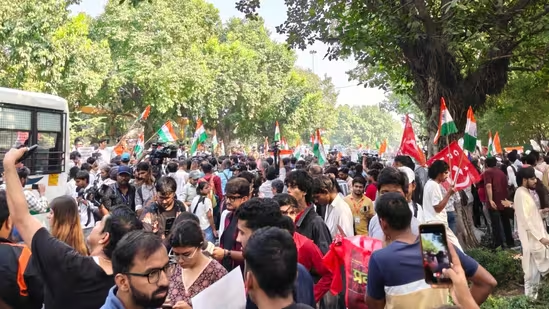
A march against Chief Election Commissioner (CEC) Gyanesh Kumar and the Special Intensive Revision (SIR) of electoral rolls began in central Delhi on Friday. Participants walked from Bangla Sahib Gurdwara in Connaught Place towards the Election Commission of India (ECI) office near Patel Chowk.
The march was organised by People Against SIR, an alliance of students, farmers and civil society groups. Cockroach Janta Party (CJP) founder Abhijeet Dipke was invited to join. The organisers said the aim was to “restore democracy”. They are demanding that CEC Kumar be removed and that the SIR exercise be scrapped.
Who Is Behind the Protest?
People Against SIR is a new group. It was formed on October 14 at Surjeet Bhavan in New Delhi by organisations representing farmers, workers, women, students, Adivasis, Dalits and minorities.
The group says the SIR exercise is illegal. It wants voter lists to be reset to their pre-2024 version and then updated through social audits, as laid down in the Election Commission Manual and guidelines of the Comptroller and Auditor General (CAG).
“We Will Not Ask for Permission”
In a statement on October 18, the platform said the “People’s March to Reclaim Democracy” would not request police permission anywhere. It also warned the police, paramilitary forces and prison authorities not to use force against peaceful protesters.
The group has also planned a “No SIR” campaign with the slogan “Har Gali Jantar Mantar, Har Gaon Jantar Mantar, Mera Ghar Jantar Mantar”. In simple words, it wants protests to spread to every street and village, not just the usual protest spot in Delhi.
Why Is the CEC Under Fire?
CEC Kumar is at the centre of a row over how the Election Commission works. An investigative report claimed that Election Commissioners Sukhbir Singh Sandhu and Vivek Joshi had raised objections at least 14 times over 10 months. Their concerns were about decisions and procedures linked to the SIR exercise.
The Election Commission has rejected these claims. It says major decisions, including the SIR of electoral rolls, were taken unanimously by the full commission.
What Does the RTI Reveal?
New details have come out through a Right to Information (RTI) application. The two commissioners had written to the Cabinet Secretary about the alleged misconduct of a senior deputy election commissioner, Maneesh Garg. The RTI documents show the Cabinet Secretariat sent these letters to the office of CEC Kumar and to the Department of Personnel and Training (DoPT).
According to the documents:
- On August 3, the secretariat proposed seeking CEC Kumar’s opinion on the letters.
- On August 4, it noted that the letters were written by the commissioners in their individual capacity and were not a formal communication from the Election Commission.
- On August 5, the two commissioners received only an acknowledgement that their letters had been received. Copies went to the DoPT secretary, the establishment officer in DoPT and the principal private secretary to the CEC.
In other words, complaints against an officer in the Commission ended up with the head of that same Commission, and no action was reported.
Why This Matters
The Election Commission is meant to run elections independently and fairly. When two of its own members are said to have objected repeatedly, and their complaints go unanswered, people start to ask whether the institution is working properly. At the same time, the Commission says its decisions were unanimous, so the two sides tell very different stories.
The voter list is the base of every election. Any dispute over how it is revised can affect public trust, which is why this issue is drawing protests.