
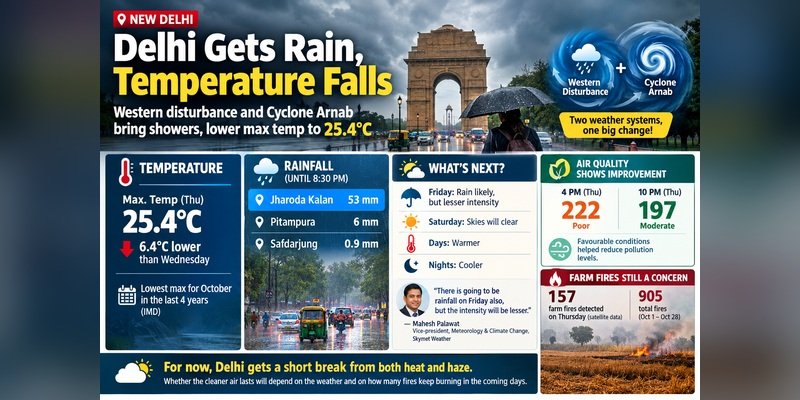
New Delhi: Thursday was a grey, damp day in Delhi, and the thermometer showed it. The maximum temperature fell to just 25.4°C, which is 6.4°C lower than Wednesday. According to the India Meteorological Department (IMD), it was the lowest maximum for October in the past four years.
So what happened? Two weather systems met over the region. One was a western disturbance, a pocket of moist air that travels in from the west. The other was Cyclone Arnab. Together, they brought light to moderate showers to different parts of the capital, and clouds covered the sky for most of the day.
Mahesh Palawat, vice-president of meteorology and climate change at Skymet Weather, said the change was down to this very meeting of the two systems. He also gave a hint of what is coming. “There is going to be rainfall on Friday also, but the intensity will be lesser,” he said. The skies should clear from Saturday. After that, days will turn warmer, while nights will get cooler.
Nights, in fact, were not cold at all on Thursday. The minimum temperature was 19.2°C, which is 3.5°C higher than the day before and 3.1°C above normal for this time of year. In short, it was a day of big swings: cooler in the daytime, warmer at night.
The rain picked up speed in the afternoon and evening, but it was uneven across the city. Until 8:30 pm, Jharoda Kalan received the most, at 53 mm. Pitampura got 6 mm, while Safdarjung, the city’s main weather station, recorded only 0.9 mm.
Air quality gets a little better
The weather did bring some relief for the air. The Central Pollution Control Board (CPCB) said the 24-hour average Air Quality Index (AQI) at 4 pm was 222. The AQI is a number that shows how clean or polluted the air is, and 222 falls in the “poor” category. By 10 pm, favourable conditions had pushed it down to 197, which is “moderate.”
Still, the problem has not gone away. Farmers in Punjab and Haryana are still burning crop leftovers in their fields, and the smoke adds to Delhi’s pollution every autumn. Satellites detected 157 farm fires on Thursday alone. Between October 1 and October 28, the total count reached 905.
For now, Delhi gets a short break from both heat and haze. Whether the cleaner air lasts will depend on the weather and on how many fires keep burning in the coming days.