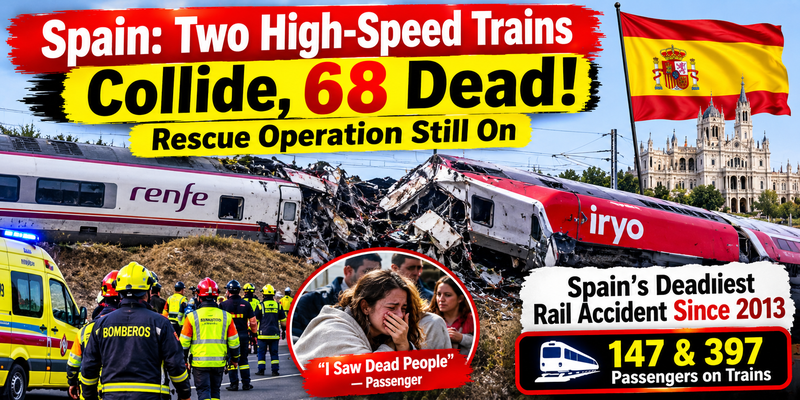
MADRID – At least 68 people died on Wednesday when two high-speed trains collided south of Madrid, and rescuers are still searching the wreckage for more victims. It is Spain’s second deadly rail accident this year and the deadliest in Europe since 2013.
What Went Wrong
Spain’s Transport Minister Oscar Puente said a train run by the operator Renfe was allowed to continue its journey even though a red signal was active. The signal was red because another train was standing still on the track ahead.
Puente explained that the red signal was triggered by a computer communications failure, which automatically stopped traffic. He said an erroneous decision was then made to restart the Renfe train, which broke protocol.
A person briefed on the incident said the stationary train belonged to the private company Iryo. It had stopped near Toledo on orders from the infrastructure manager Adif because of a signal fault. The Renfe train then hit it at high speed, and several carriages of both trains came off the tracks.
Scenes at the Crash Site
The trains crashed just after 9:00 am. Ambulances, funeral vans and helicopters gathered beside one train on a raised section of track. Twisted metal and broken panels were scattered across an embankment, and at least three carriages tumbled down it.
Survivors walked along a nearby road. Some had blood on their clothes or bandaged wounds, while volunteers handed out water to others.
The head of the Castilla-La Mancha regional government said the death toll had reached 68. Rescue workers are still checking the carriages one by one for more victims. Authorities have not given a number for the injured, but Health Minister Mónica García asked people to donate blood.
According to regional spokesperson Esther Padilla, 147 people were on the Iryo train and 397 were on the Renfe train.
Passengers Describe the Impact
Miguel, who was in the rear carriage of one train, told COPE radio he heard a huge roar and a thud that lasted about 10 seconds. Through the window, he saw a wrecked train.
Eduarda, who was on the Iryo train, told Cadena SER radio that a strong impact threw her forward. She first thought the train had made an emergency stop. She understood how serious it was only when she saw injured people and was told to evacuate. After climbing down the embankment, she saw part of the train hanging down the slope and a fire in one carriage. Emergency teams arrived within about 20 minutes, she said, adding, “I saw dead people.”
Companies Respond
Renfe said its train kept going after being authorised to do so, and then a collision happened. It said the Iryo train had been stationary “for reasons we don’t know.” The company added that the exact sequence of events must be established by the investigation. Renfe set up a special line for victims’ families and offered its condolences. Iryo said it had activated emergency protocols.
Second Crash This Year
In January, a train derailed and hit an oncoming high-speed train near Adamuz, in Cordoba province. That accident killed 46 people and led to debate about how much money has been invested in railway maintenance. Its cause is still being investigated. A preliminary report by Spain’s Civil Guard in February named defects in the track, rail or weld as the main theory, while keeping seven other possibilities open.
Wednesday’s crash is the deadliest in Europe since 2013, when a derailment at Santiago de Compostela in Spain killed 80 people.