
Thousands Left Without Power
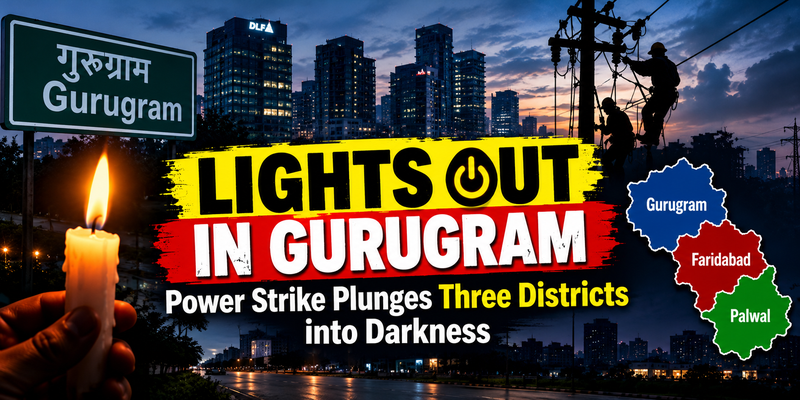
Large parts of Gurugram, Faridabad and Nuh went dark after electricity employees began an indefinite strike against the privatisation of power distribution in Haryana. The outages started at around 10 pm on Wednesday and continued into Thursday, affecting thousands of homes and industrial units, residents said.
An official, who did not want to be named, said the power department received more than 3,000 outage complaints within the first 12 hours of the strike.
Homes Struggle Without Electricity or Water
In many residential sectors of Gurugram, inverter backups ran out within hours, forcing families to switch to generators. The blackout also hit water supply in several areas. Residents said the water they had stored would last only a few more hours.
Some people came out on the streets to protest. Resident Shiv Kumar Sharma said the lack of power had made the water shortage even worse. “Electricity and water are both essential services. Where is the government?” he asked. He urged the government to either settle the employees’ demands or send disaster management teams to restore supply.
Factories Come to a Standstill
Industrial areas such as Daulatabad, Kadipur, Basai and Sector 37 were also hit. Deepak Maini, chairman of the Progressive Federation of Trade and Industry, said Sector 37 had no power since Wednesday night. He warned that machines and production had stopped across hundreds of units, raising the risk of heavy losses. Delays, he said, could affect finished goods and timely deliveries from Haryana’s financial hub.
Trouble Spreads Beyond Gurugram
In Faridabad, residents of the New Industrial Township-2 area blocked a road to demand power. Police reached the spot, calmed the protesters and cleared the road. In Nuh district, daily life was badly disrupted in Punhana, Nagina and Firozpur Jhirka.
Why Are Workers on Strike?
The strike is against a decision by the Haryana Electricity Regulatory Commission to give private company Eleven Power a parallel licence to supply electricity in Gurugram and Nuh for 25 years.
Employee unions call the move anti-worker and against public interest. They say handing over high-revenue areas to a private firm could weaken the state-run Dakshin Haryana Bijli Vitran Nigam (DHBVN) and put publicly built electricity infrastructure in private hands.
The unions also fear that:
- Consumers, farmers and small businesses could face higher electricity bills.
- Private companies may focus on profitable city areas, leaving rural and farm consumers to the state-run utility.
- Around 40,000 regular, contractual and outsourced employees and engineers could see their jobs put at risk.
Talks Fail to End the Strike
The employees’ joint forum had announced a statewide strike from October 22 to 24. Gurugram Deputy Commissioner Uttam Singh met the striking workers until late Wednesday night and urged them to reconsider. The talks ended without any agreement.
Residents also questioned how authorities were handling the crisis. Sharma said even officers appeared helpless. The Superintending Engineer of DHBVN’s Operation Circle Gurugram-I could not be reached for comment.
What Next?
With the strike scheduled to run until October 24, residents and businesses are hoping for a quick breakthrough. For now, the key questions are whether the government will hold fresh talks with the unions and how soon power and water supply can return to normal.