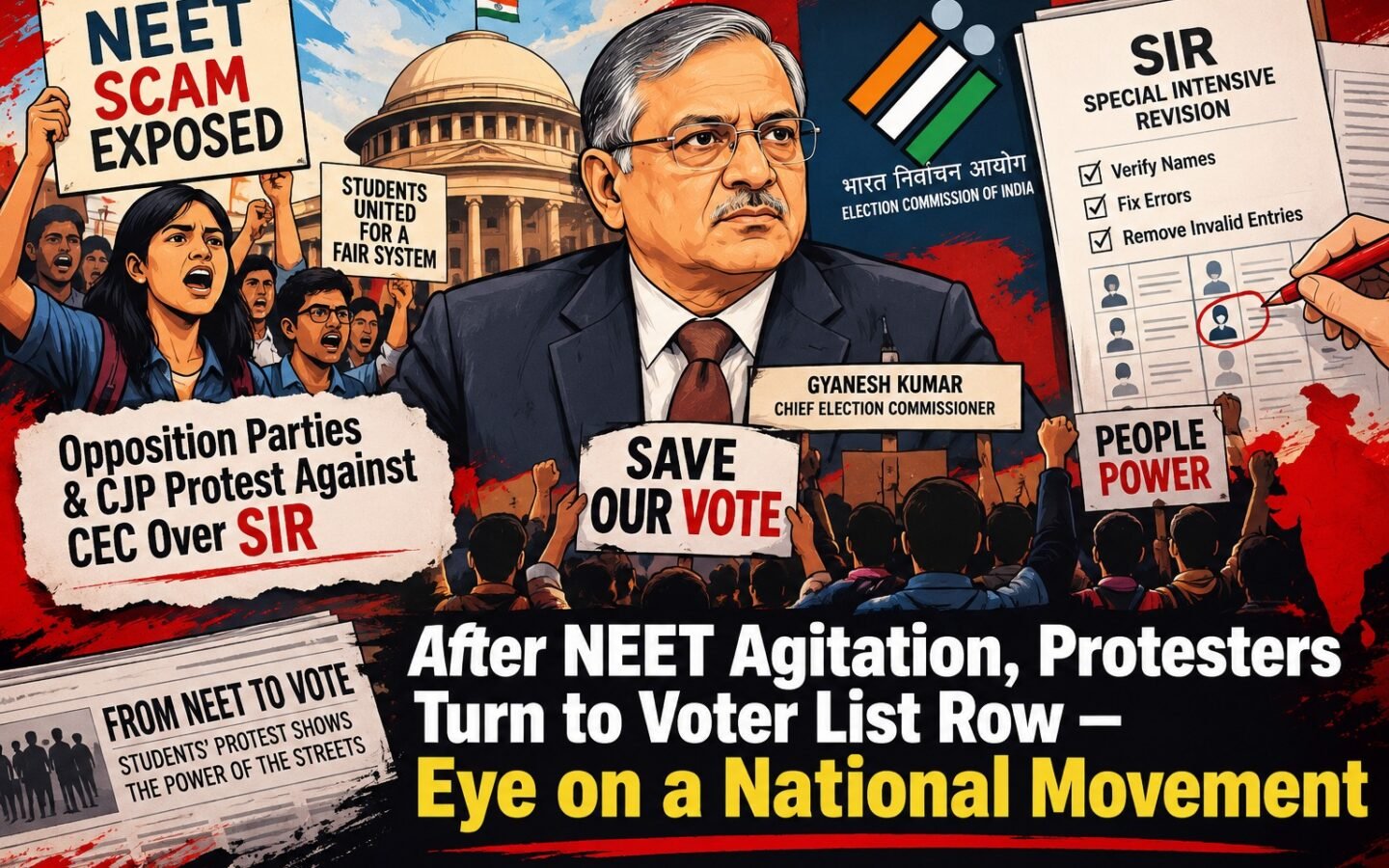
After a student-led NEET agitation ended with a minister’s exit, protesters are hoping to turn the voter list row into a national movement
New Delhi: Opposition parties and the Cockroach Janta Party (CJP) have launched a protest against Chief Election Commissioner Gyanesh Kumar over the Special Intensive Revision (SIR) of electoral rolls. Many political watchers feel the aim is bigger than one issue: they want to build a movement that spreads across the country.
In simple terms, the SIR is a check-up of the voter list. The Election Commission goes through the names, fixes mistakes and removes entries that shouldn’t be there. Critics worry that in the process, genuine voters may lose their names. The Commission says it is only cleaning up the rolls.
Riding on a recent win
The timing matters. Just a few weeks ago, the CJP led a month-long protest by students and young people over the NEET paper leak. NEET is the entrance exam for medical courses, and a leak shatters the hard work of lakhs of students.
That protest ended in July, when Union Education Minister Dharmendra Pradhan resigned. CJP leaders called it proof that people on the streets can force the government to answer for its failures. Now they want to repeat it, this time on the right to vote.
India’s protest history is mixed
Mass movements in India have had very different endings. Some made governments back down. The farmers’ protest is the best-known example, ending with the repeal of three farm laws in 2021.
Others never fully got what they wanted but still changed the political map. Jayaprakash Narayan’s movement in the 1970s shook the government and paved the way for the Janata Party’s win in 1977. Anna Hazare’s anti-corruption campaign in 2011 led to the Lokpal law and also helped a new political party emerge.
And then there are movements that simply ran out of steam, hurt by weak planning, quarrels among leaders, or a government that chose to wait.
What could decide this one?
First, will ordinary people care? A paper leak hits students directly. Voter list revision sounds technical, so protesters must explain why it matters to every voter.
Second, unity. The Opposition parties and the CJP have different styles and interests, and keeping them on one page won’t be easy.
Third, staying power. Movements powered only by anger often fade after a few weeks.
There is also a bigger question. The Election Commission is supposed to be independent, and a protest aimed at its chief is unusual. The Commission’s supporters say it is just doing its constitutional job. Its critics say an umpire must stay above doubt.
What next?
Both sides appear firm for now. Protesters say they will continue until their concerns on the SIR are addressed, while the Commission calls the revision routine and necessary.
Whether this agitation forces change, reshapes politics or fades away will be clear only in the coming weeks. But one thing is evident: after the NEET protest, many young Indians believe the street still has real power.