
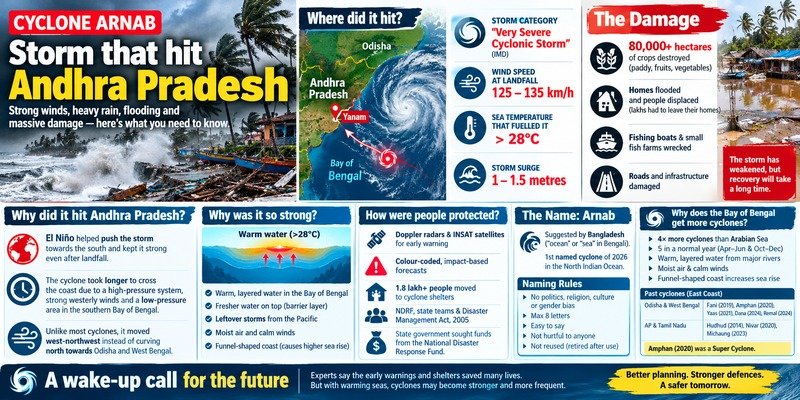
New Delhi: Cyclone Arnab came ashore near Yanam on the Andhra Pradesh coast with winds of 125 to 135 km/h. People died. How many is not yet clear. What is clear is the damage: more than 80,000 hectares of standing crops destroyed, fishing boats smashed, and seawater pushed deep into farmland. The storm has weakened, but the cleanup is only beginning.
The India Meteorological Department (IMD) rated Arnab a Very Severe Cyclonic Storm, a label for sustained winds of 118 to 166 km/h. It began as a low-pressure area over the Bay of Bengal and strengthened quickly over water warmer than 28°C. Fresh river water floats on the Bay’s surface and blocks cooler water from rising, so the top layer stays hot. Experts call this sudden surge in power rapid intensification.
Most storms from the Bay swing north towards Odisha and West Bengal. Arnab did not. It moved west-northwest, pushed south by El Niño, the warming of the Pacific Ocean that alters winds worldwide. El Niño also helped the cyclone hold its strength after landfall. Several other weather systems slowed its crossing, so rain and wind lasted longer than usual.
Farmers lost the most. Paddy and horticulture crops were wiped out across the delta region. A storm surge of 1 to 1.5 metres carried salty water into the Krishna-Godavari delta, and salt in the soil can hurt harvests for seasons to come. Trawlers and small fish farms were destroyed too, leaving fishing families with no boats and no income.
Early warnings, officials say, kept the toll down. The IMD tracked the storm with Doppler radars and INSAT satellites and sent colour-coded alerts that spelled out likely damage, not just the storm’s route. The National Disaster Response Force (NDRF) and state teams moved over 1.8 lakh people to cyclone shelters. The state has now asked the Centre for funds from the National Disaster Response Fund.
The storm’s reach went well beyond the coast. In Delhi on Thursday, Arnab’s interaction with a western disturbance brought light to moderate rain. The maximum temperature fell to 25.4°C, the lowest for October in four years, while the minimum rose to 19.2°C. “There is going to be rainfall on Friday also, but the intensity will be lesser,” said Mahesh Palawat of Skymet Weather. Skies should clear from Saturday.
The name Arnab was proposed by Bangladesh and means “ocean” in Bengali. It is the first named cyclone of 2026 in the North Indian Ocean. Names come from a 13-nation panel and are never used twice.
The Bay of Bengal sees roughly four times as many cyclones as the Arabian Sea, thanks to warm water, humid air, calm upper winds and leftovers from Pacific typhoons. Past storms include Fani, Amphan, Yaas, Dana and Remal in the east, and Hudhud, Nivar and Michaung in the south.
The Arabian Sea is changing as well. A study by the Indian Institute of Tropical Meteorology, Pune, found it is warming faster than the Bay. Cyclones there are 52% more frequent and last about 80% longer than two decades ago.
For now, officials are still counting losses. For farmers and fisherfolk, recovery will take far longer.