
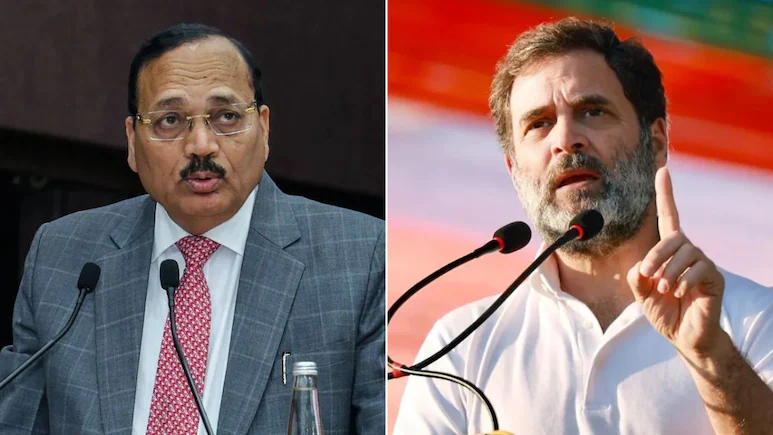
Chief Justice also ends live streaming of “mentioning” sessions after the exchange
New Delhi: Chief Justice of India Surya Kant on Tuesday sharply reprimanded a lawyer who wanted an urgent hearing in a disproportionate assets case against Rahul Gandhi, the Leader of Opposition in the Lok Sabha. The CJI asked whether the request was really about getting media attention, and said the attempt had neither a clear basis nor any real merit.
The lawyer’s argument was based on something Gandhi had said recently at an event. Gandhi had claimed he was in touch with 200 officials of the Enforcement Directorate (ED) and the Central Bureau of Investigation (CBI). The lawyer said that was reason enough for the court to list the matter quickly.
The Chief Justice did not agree. “Have you spoken to any news channel for this?” he asked. He added that the lawyer wanted to raise the issue only for the sake of media attention, and said there was “no head, no tail” to the request.
Requests like this are called “mentionings,” where lawyers ask the court to list a case for hearing. After the exchange, the CJI verbally told court staff that live streaming of these sessions should be discontinued from now on.
A Word for the Agencies
The court also made a broader point. If any agency has information about disproportionate assets held by anyone, it said, it can act on its own, and it does not need a court order to do so. The term refers to wealth that cannot be explained by a person’s known income.
Where the Case Stands
The case began with a complaint by Vignesh Shishir, a BJP worker from Karnataka, who made several allegations about Rahul Gandhi’s assets. In May, the Lucknow bench of the Allahabad High Court directed the CBI and the ED to look into the allegations, and sought responses from the complainant and both agencies.
Gandhi challenged that order in the Supreme Court. He also filed a separate petition asking for the case to be moved from the Allahabad High Court to the Delhi High Court.
In August, the Supreme Court put a temporary stay on the High Court’s order. It also asked how the High Court could have passed such an order without hearing Gandhi first. The top court told the CBI and the ED not to file any reports in the matter before the High Court for now, and asked the High Court to put its proceedings on hold.
Tuesday’s hearing came with that August order still in force. In practical terms, that means the High Court case is paused, and the agencies cannot send their reports there until the Supreme Court decides otherwise.
The main petitions have not yet been taken up. No response from Rahul Gandhi or the Congress to Tuesday’s remarks could be found at the time of writing.
Beyond This Case
The exchange says something about how the court wants urgent hearings to be sought. A lawyer asking for early listing is expected to give a legal reason, and a statement at a public event is not necessarily one. The Chief Justice’s decision on live streaming also suggests he is wary of mentioning sessions turning into a source of headlines.
It is worth remembering that a lawyer’s plea being turned away is not a ruling on the case itself. The questions that matter here, including whether the allegations have any substance and whether the Allahabad High Court was right to order a verification, are still waiting for the Supreme Court.