
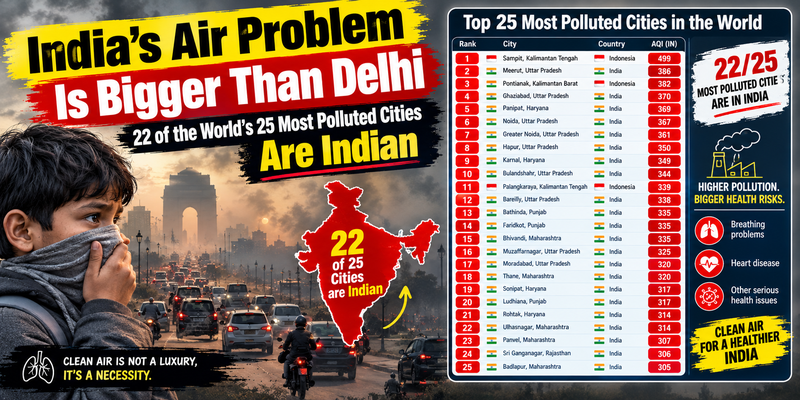
Meerut, Ghaziabad and Panipat sit near the top of a live global ranking, with cities across four states breathing dangerously dirty air.
New Delhi: When people talk about pollution in India, they usually talk about Delhi. But a live ranking of the world’s most polluted cities shows the problem has spread much further. Of the 25 cities on the list, 22 are in India, with places in Uttar Pradesh, Haryana, Punjab and Maharashtra showing up again and again.
The Worst Hit Cities
The ranking comes from AQI.in and was taken at 11 am. It uses the Air Quality Index, or AQI, a number that shows how clean or polluted the air is. A higher number means the air is more harmful to breathe.
Meerut in Uttar Pradesh is second in the world, with an AQI of 386. Ghaziabad comes in fourth at 370, and Panipat in Haryana is fifth at 369. Noida (367) and Greater Noida (361) are also in the top 10.
Behind these numbers are millions of people who are breathing this air every day, and who face real health risks because of it.
A Problem That Covers North India
Most of the cities on the list sit in or around the National Capital Region (NCR) and the states next to it. That suggests the cause is regional, not something limited to one city.
Besides the cities already named, the list includes Hapur, Muzaffarnagar, Moradabad, Sonipat and Karnal. Some places farther away are on it too: Bhiwandi and Thane in Maharashtra, Bathinda and Faridkot in Punjab, and Sri Ganganagar in Rajasthan.
Air pollution doesn’t respect city limits. Smoke, dust and fumes from vehicles, factories, construction and other activities travel with the wind, so one area’s pollution quickly becomes its neighbour’s problem too.
So, Where Is Delhi?
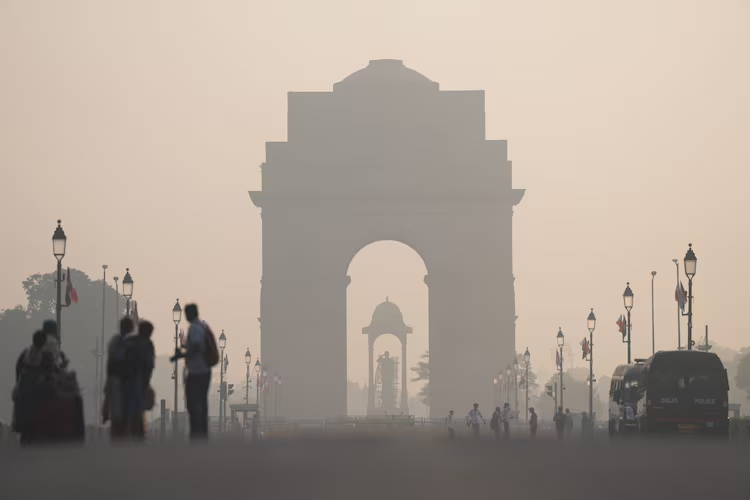
Delhi isn’t in the top 25 this time, but that doesn’t mean its air is fine. On October 24, the capital saw a small improvement. According to AQI.in, Delhi’s AQI fell to 296 at 9.31 am, down from 337 at the same hour on October 23.
A drop of 41 points brings some relief, but the air is still heavily polluted. It’s also worth remembering that this ranking is only a snapshot of one moment. Positions can change through the day as pollution levels go up and down, so Delhi missing from the list shouldn’t be read as a lasting fix.
What Lies Ahead
Winter is coming, and that usually makes things harder. Winds get weaker and the weather shifts, so pollutants don’t spread out as easily and stay close to the ground.
Smoke from crop-residue burning in nearby states can add to what traffic, construction and industry are already putting into the air.
With so many Indian cities near the top of a global list, officials and experts say steady, long-term action against the sources of pollution is badly needed.