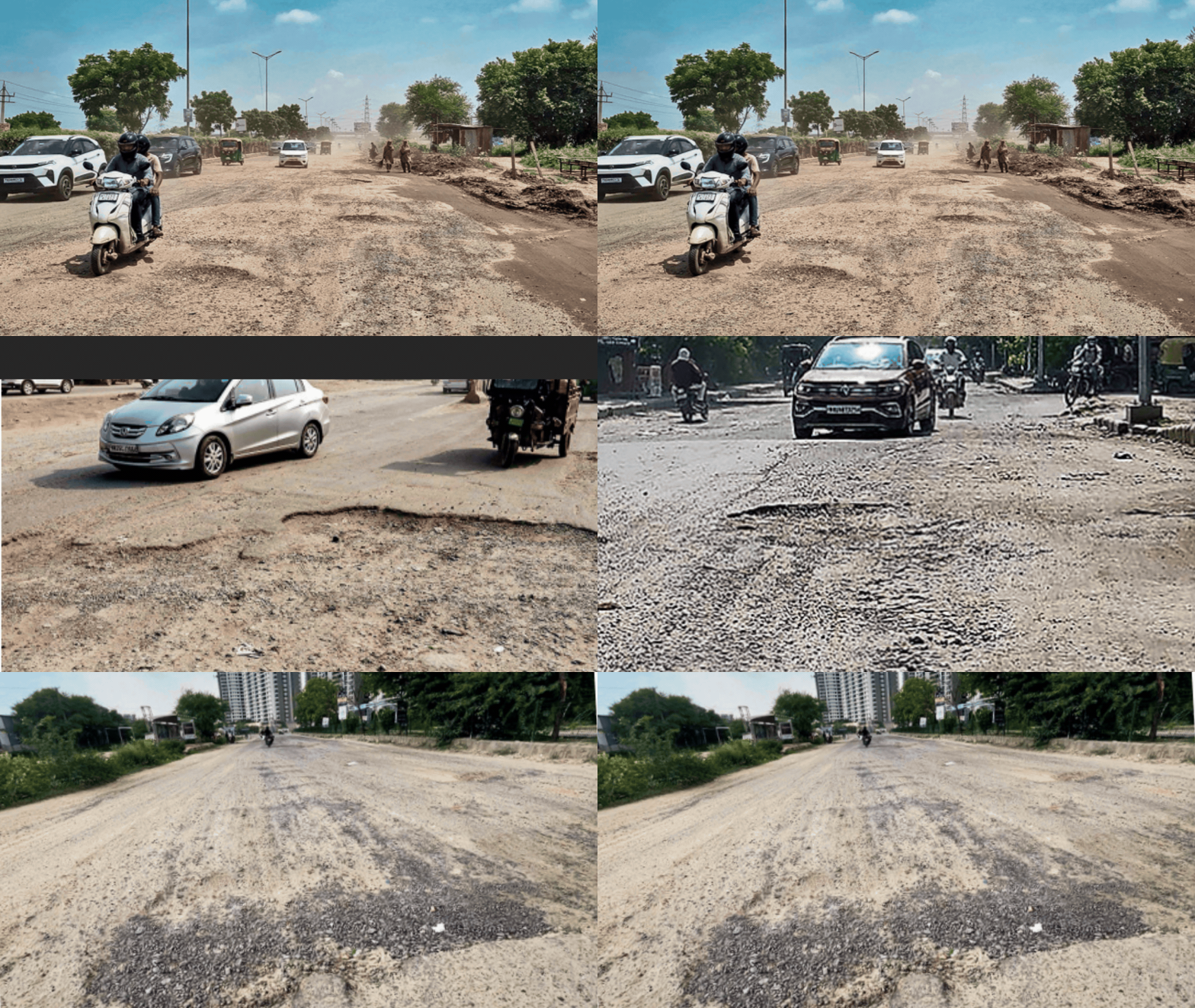
GURUGRAM — The Haryana government has initiated a comprehensive 30-day campaign to repair 100 roads in Gurugram, with a strict deadline of November 7 for its completion. Rajesh Khullar, the Chief Principal Secretary to the Chief Minister of Haryana, issued the orders for the campaign in a joint coordination meeting comprising of the Gurugram Metropolitan Development Authority, Municipal Corporation of Gurugram, and Haryana Shehri Vikas Pradhikaran at the PWD Guesthouse.
Apart from the launching of the road repair campaign, the administration has undertaken three additional steps, including the advent of Fast Track Civic Grievance System, development of 10 Iconic Routes, and the initiation of “Our 500 Metre Area” community initiative.
End-to-End Road Revamp with QR Code Tracking
Unlike routine patchwork or minor pothole-filling, officials confirmed that the 100 selected stretches will undergo end-to-end reconstruction:
- Scope of Upgrades: Each chosen stretch will be at least 500 meters long and will receive full recarpeting, new footpaths, fresh lane markings, streetlighting, proper signage, and removal of roadside encroachments and waste dumps.
- Public QR Codes: Every upgraded road will feature an on-site information board embedded with a QR code. Residents can scan the code to view the department in charge, the assigned engineer’s name, and scheduled start and end dates.
- “24-hour challenge” and ₹5,000 penalty for negligence
- In connection with the longstanding municipal complaints, the government introduced an online grievance mechanism in which the public can upload images and locations of sewage overflow, big potholes, and street-light failures when dispatching any complaint. However, people will not be required to give their personal contact numbers.
- Complaints will have to be settled within 24 hours if urgent, 48 if severe, or within 72 hours. If a study indicates and proves that the problem was caused by the official’s negligence, an automatic fine of ₹5,000 will be deducted from his salary.
10 ‘Iconic Roads’ and Civic Cleanliness Drives
The meeting also approved the transformation of 10 major city routes into high-standard “iconic roads” equipped with public amenities:
- Strict Civic Enforcement: Stretches will feature designated smoking zones and wheelchair assistance. Littering, spitting, and discarding chewing gum in public will attract digital-only spot fines issued by enforcement personnel wearing body cameras.
- Community Cleanliness: Under the “Our 500 Metre Area” (Hamare 500 Metre Area) programme, resident welfare associations (RWAs), schools, and market bodies will be mobilized to adopt and clean areas within a 500-metre radius of their premises.
Weekly Scorecards vs. Resident Skepticism
To maintain public accountability across GMDA, MCG, and HSVP, a signed weekly progress scorecard will be published in local newspapers every Saturday.
While welcoming the initiative, local residents voiced caution, noting that previous platforms like the Swachh City Portal struggled with weak follow-up once initial inspection drives concluded. Civic bodies stated that joint inter-agency execution would ensure the repairs endure well beyond the November 7 deadline.