
NEW DELHI: For almost a year, India and China seemed to be slowly repairing their relationship. Now a rare statement from a senior Indian official has made many people wonder whether that calm is as strong as it looked.
What the border police chief said
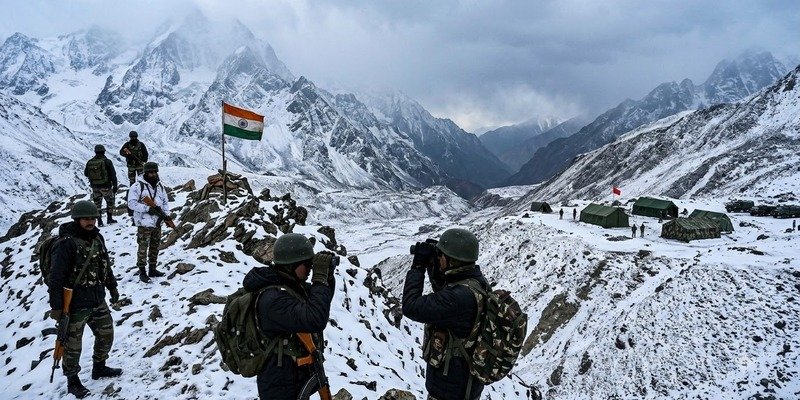
Shatrujeet Singh Kapur, head of the Indo-Tibetan Border Police (ITBP), told a gathering of officers in Rajasthan that Indian and Chinese soldiers have come face to face at several places in Arunachal Pradesh. He said the stand-offs are still going on.
According to Kapur, the trouble began in July. Both sides first pulled back, but a few days later Chinese troops returned in larger numbers. They set up tents about six to seven kilometres inside what India sees as its side of the Line of Actual Control (LAC).
The remarks caused a stir because serving officers rarely speak about border issues in public. Normally, the defence or foreign ministry does that.
A border that was never properly drawn
The LAC is the unofficial line that separates the areas held by the two countries. It is about 3,440 km long, and India and China have argued over it for decades. China says Arunachal Pradesh is part of southern Tibet. India rejects this and calls the state an integral part of the country.
Much of the border has never been clearly marked. Rivers shift, and lakes and snowy peaks make it hard to say where one country ends and the other begins. So soldiers sometimes meet face to face, which can lead to fights.
The two countries fought a war in 1962, which India lost. In June 2020, a clash in Ladakh’s Galwan Valley killed at least 20 Indian and four Chinese soldiers. It was the first deadly clash between them since 1975.
A thaw that now looks shaky
After Galwan, ties fell sharply, and trade and travel suffered. In 2024, the two sides agreed to ease tensions at the border. Since then, they have moved to restore direct flights and relax visa rules. Chinese President Xi Jinping also visited India in September for the Brics summit, his first visit in seven years.
Kapur’s words have raised doubts about how much has really changed on the ground.
What each side says
The opposition Congress party again accused Prime Minister Narendra Modi of giving in to Beijing. Senior leader Jairam Ramesh said on X that the government was silent on this serious issue. The Indian government has not clearly denied Kapur’s account.
Foreign ministry spokesman Randhir Jaiswal said the situation gets disturbed from time to time when Chinese forces move away from usual patrolling patterns. He said both countries are talking through military and diplomatic channels. China said it has followed its agreements with India and only carries out normal patrols.
Shyam Saran, a former Indian foreign secretary, said such moves are not enough to start a war, but can create “new facts on the ground.” Zhou Bo, a retired Chinese colonel, said both sides learned lessons from Galwan. He also noted that Chinese media had not reported the stand-offs.
More than a border issue
Trade between the two countries reached $151 billion last year, but about $131 billion of it was Chinese exports to India. India relies on China for machinery, rare earth magnets, electric vehicle batteries and medicines.
Last week, China announced limits on exports of tunnel-boring machines used to build metro lines and highways. They are not aimed only at India, but they could slow its building projects. Last year, China also restricted rare earth magnets, which caused shortages for Indian industries. India is trying to make them at home, but that will take time and money.
Christopher Clary, a professor at the University at Albany, said China’s policy is designed to make India’s rise harder.
Life along the border
For villagers near the border, the worry is immediate. Tongam Rina, a senior journalist at the Arunachal Times, said some villagers cannot reach their grazing lands because of Chinese intrusion. She said this has been going on for a long time.
For now, both governments say they are in talks. But with stand-offs reportedly continuing and trade ties so tangled, the coming weeks will show whether the thaw can hold.