
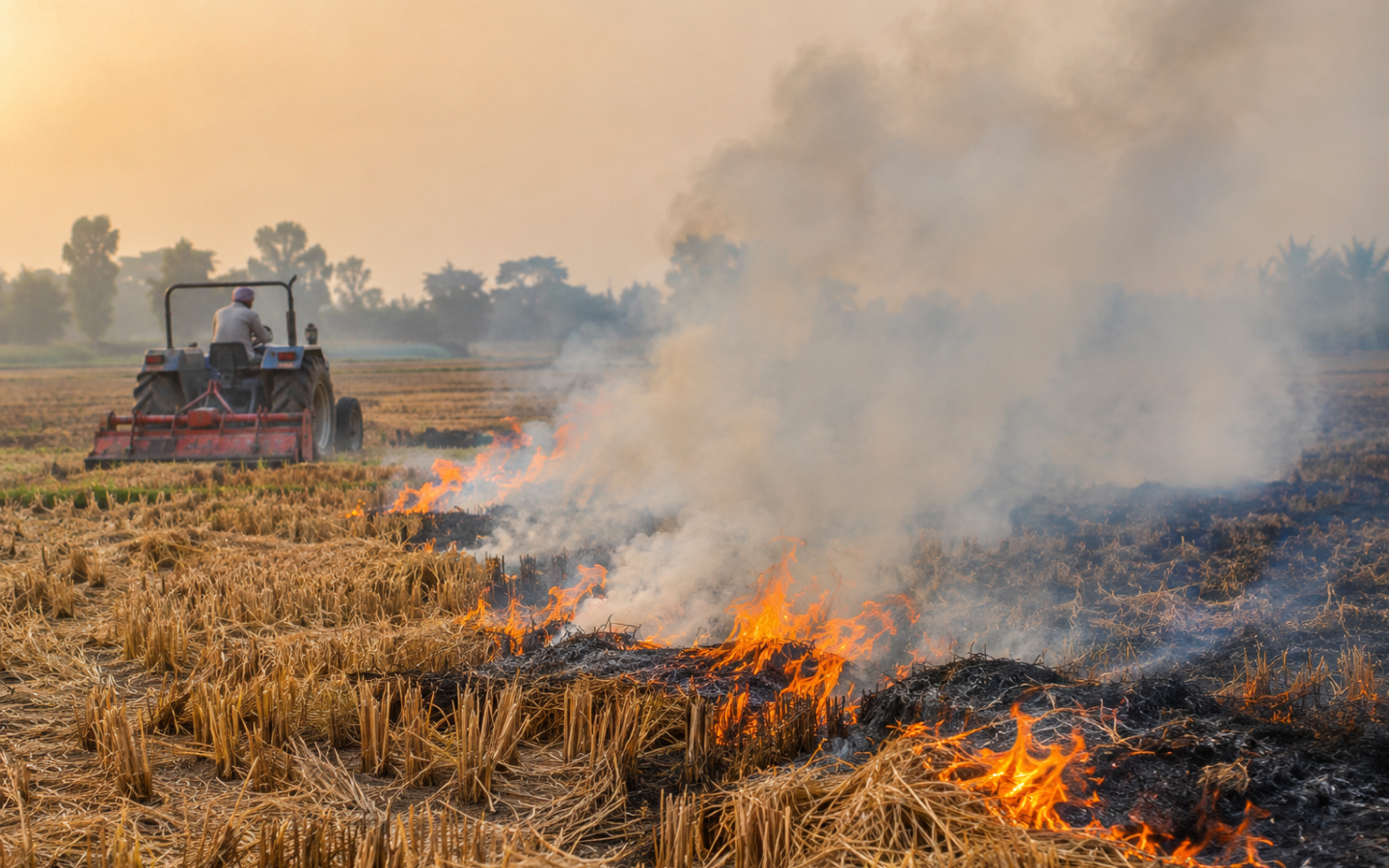
New Delhi: Every October, when the monsoon packs up and the evenings turn golden, small fires start popping up across the paddy fields of north India. By morning the smoke has spread out into a haze, and a few days later it reaches Delhi. It’s easy to blame the farmer holding the match. Ask the farmers themselves, though, and the story gets a lot more complicated.
What exactly is being burned?
After paddy (rice before it is milled) is harvested, stiff dry stalks about a foot tall are left standing in the field. That’s stubble. Setting it on fire is the quickest way to clear the land for the next crop.
This year’s fires have already begun. The satellite monitoring group CREAMS at the Indian Agricultural Research Institute counted 287 paddy residue fires between September 15 and October 6, going by its October 6 bulletin. Madhya Pradesh topped the list with 118. Punjab came next with 88, then Uttar Pradesh with 65. So this is no longer just a Punjab problem.
The harvester that left the stalks behind
Decades ago, farmers cut paddy by hand, right near the root. The straw went to the cattle, and what was left got ploughed back into the soil. Wheat wasn’t sown for almost two months, so nobody was in a rush.
Then the combine harvester showed up in the mid-1990s. It cuts the crop and separates the grain in one pass, and it does in an hour what used to take days. But it cuts high. “When we harvest with machines, we have to leave about a foot,” one farmer told Kisan Tak.
Now the farmer has to deal with that foot of stalks somehow. He can clear it by hand, which is cheap but takes ages. He can use machines that chop the straw and sow wheat in the same go, which is quick but costs a fortune. Equipment like that runs Rs 1.5 lakh to Rs 2.5 lakh, and the tractor needed to pull it costs several times more. For someone with two to five acres, that’s out of reach. Or he can strike a match, which is fast and nearly free. For most farmers, it’s not a hard choice.
Selling the straw sounds like the smart fix, but it has its own problems. Kurinji Kemanth of the Council on Energy, Environment and Water (CEEW) says biomass plants lose 15 to 25 per cent of their bales every year, because damp straw starts rotting in storage.
A calendar with no spare days
Back in the 1960s, the Green Revolution turned Punjab and Haryana into the country’s food bowl. Paddy drinks a lot of water, and decades of pumping brought the water table down.
So in 2009, Punjab passed a law. Farmers can’t sow paddy nurseries before May 10, and they can’t transplant seedlings before a date the state announces. The point was to stop the crop from draining groundwater before the rains arrive. The water got more time. The farmers got less.
Paddy now comes off the fields around October 20, and wheat should be in the ground before mid-November. That leaves about 25 days to harvest, clear the field and sow again. Sow wheat too late and early warm weather can leave the grain half-filled. Even farmers who sell their straw feel the pinch. Kemanth says rushed collection means wetter bales and poorer quality.
Why the soil can’t just eat it
Couldn’t the straw simply rot into the soil? It could, but slowly. Dr Sandeep Sharma, a soil microbiologist at Punjab Agricultural University, says paddy straw is unusually stubborn. It’s full of lignin, the woody glue that keeps stems stiff, and silica, a glassy mineral. It also has plenty of carbon but very little nitrogen, so the microbes that break it down have to borrow nitrogen from the soil. Cooler weather after the harvest slows them even more.
Research suggests they need about three weeks to do the job. The calendar doesn’t give them that.
What the fire does underground
Studies in Haryana found that burning straw heated the soil to around 55°C and wiped out many helpful microbes. Most recovered within 30 to 60 days, Dr Sharma says, though their work stayed weaker for a while. He is careful to add that permanent damage hasn’t been proven everywhere.
Dr BL Attri of ICAR’s Directorate of Mushroom Research takes a darker view. He estimates India produces 125 to 140 million tonnes of paddy straw every year and burns 35 to 40 million tonnes of it. In his words, burning destroys the carbon, nitrogen and sulphur in the straw. The alkaline ash it leaves behind changes the soil’s pH, and the loss of organic matter can make fields less fertile.
The fires nobody counts
Almost all our numbers come from satellites, and they pass over India only a few times a day. If a farmer lights his field at 4 pm, the satellite may already be gone. Small fires get missed too, because the average Punjab farm is smaller than the patch a single satellite pixel covers.
A 2025 study warns that burning may be moving towards late afternoon, which means some fires could be going uncounted. A fire the satellites miss still makes smoke.
So how much of Delhi’s smog is this?
The same study estimated that crop burning caused 18 per cent of PM2.5 pollution in Delhi and nearby areas between October 16 and November 30 in 2022. That dropped to 16 per cent in 2023 and 9 per cent in 2024. PM2.5 refers to tiny particles that can travel deep into your lungs. On days when the wind carried smoke straight from the farms, the share shot up to about 50 per cent, but only for two or three days at a time.
Delhi also makes plenty of its own pollution all year, from traffic, factories, dust and construction. Stubble smoke is a heavy guest that turns up for a few bad days. It isn’t the whole story.
Where this leaves us
The match is just the last step in a longer chain: a machine, a law and a very tight calendar. If burning does this much harm and not burning is this hard, what would it actually take to stop it? The next part of this series looks at exactly that.